

A few notes following ‘Opening the Space’ with freelance dance artists at Yorkshire Dance, Leeds, November 24th 2023
In the lead up to the network gathering at Yorkshire Dance in Leeds, Steffi, Chris and I had meet to design the sessions. As our first open session we were keen to leave plenty of space for playful exchange, visualising and reflection as a basis of understanding artists perspectives on our questions.
In seeking to manifest and discuss various aspects of dance ecosystems we sought to address:
Who are the key agents and what are their relationships? What are the qualities of connections between agents? What sustains or disrupts these relationships?
What feeds into and drives our ecologies? What are the landscapes in which our ecosystems are operating?
The 2 hour workshop with the Leeds based dance artists began with a very (very) short statement about ‘ecologies’: The simplest definition of an ecosystem is that it is a community or group of living organisms that live in and interact with each other in a specific environment.
Plus a couple of notions about dance / performing arts ecosystems:
Ecologies are not already there, ecologies must be performed. Flat ecology is thus about a positioning within a power field, diagramming and scoring possibilities that can be enacted, having in mind posthuman justice, which is at odds with modern, capitalist, colonialist, and imperialist world-making projects that perpetuate domination of life. (Nikolić, PhD Submission)
The arts ecosystem is ‘a self-organising, intricate, dynamic network of numerous agents looped together, competing for but primarily sharing resources, mutually evolving and responding to emerging innovations, and without a governing consciousness.’ (Gallasch, Art in a Cold Climate: Rethinking the Australia Council)
Ecological thinking in this project seeks to enable us to take note of the physical and social ‘habitats’ in which we seek to make, study and produce dancing. It helps us recognise the features, atmospheres, connections and disconnections of how dance, dancing and dance research meets ‘the world’. What are the social structures, creative and regulating practices through which we activate dance?
I am interested then in the patterns, threads and shapes our dance ecology: How are they are shaped, what makes some threads more or less robust, what are the characteristic’s of our ecologies? In asking these questions, and in seeking to understand shapes, the questions are inherently political in nature.
The session is divided into a series of short tasks, the first of which seeks to open up a shared understanding of ecosystems.
TASK: Collecting terms and resonances: Use the chat function or sticky notes to list terms or ideas that in any way come to you in relation to the notion ecosystems or arts as an ecosystem

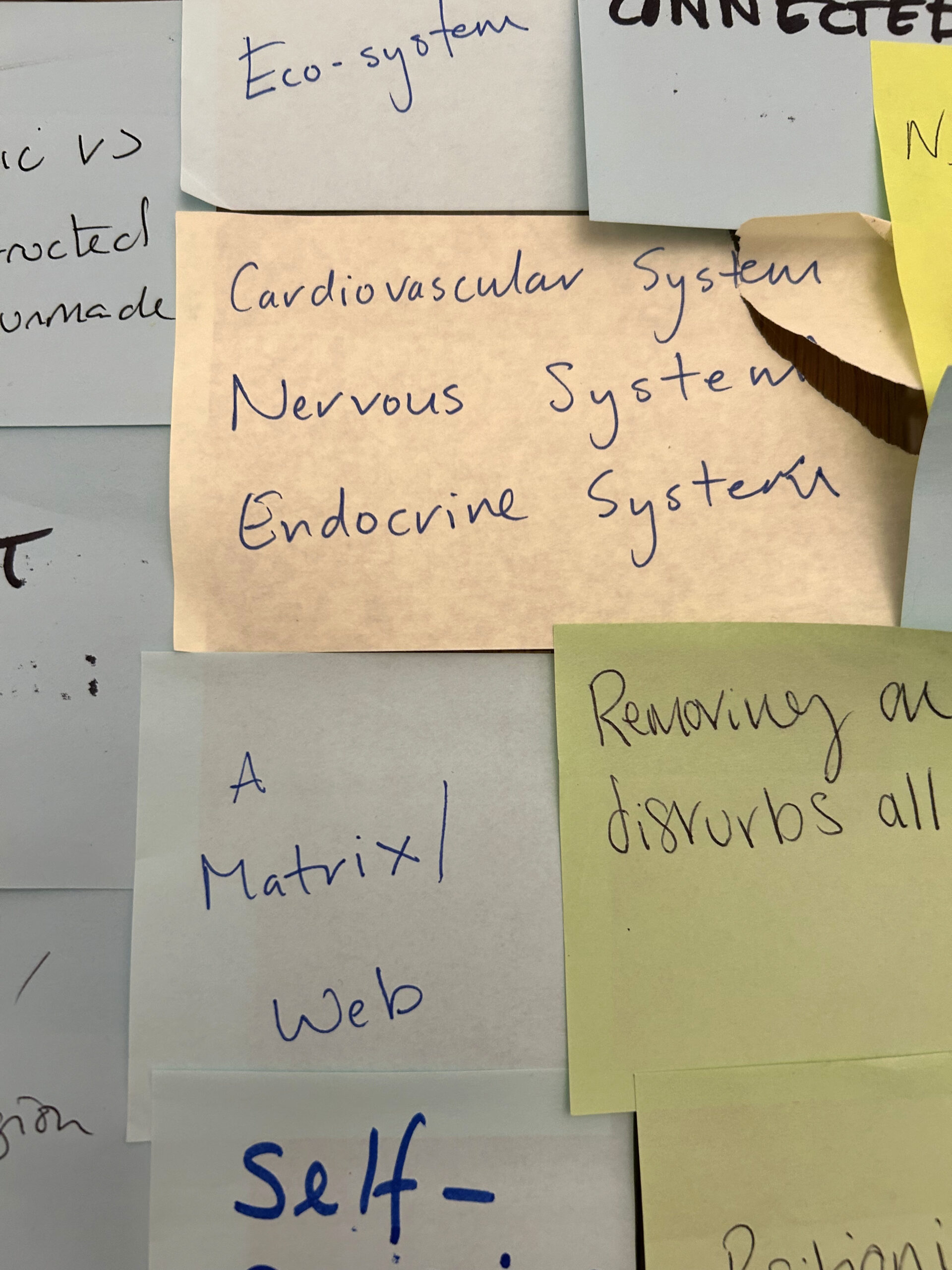

Sticky-notes capture ideas and lists of words are made:
Relationship
Friendship
Interdependence
Evolving
Changing
Movement between
Oscillation
Cycle
Seasonal
Agency
Dialogue
Communication
Performed
Bodily
Fascial
Mycelium
Nurturing
Care
Collaboration
Self-governing
Pragmatic coalition
Resources
Funding
Crisis
Fragile
Instability
Tough
Hardship
In my grouping of words above I’m struck by the largely generative nature of many of the words – the sense that ecologies arise in co-formed ways and that they are also (always) changing. I wonder as the session continues about the last set of words – from Crisis to Hardship – and the extent of agency that is or isn’t possible by independent dance artists in these ecologies and how spaces are made for the increasingly wonderfully particularized approaches to dance practice.
The next task opens to the dancer’s experience and places the emphasis on how individuals interact – opening us to a discussion as to the landscape in which these interactions take place.
TASK: Visualise ecosystems in which you work: Map the systems through which your work operates.
What resides in your ecosystem? What is close/distant? What shape, rhythms, patterns or pulses does your ecosystems have? What are the characteristics of the material and social context of your dance ecosystem? Is the ecosystem in movement? What is important/difficult?
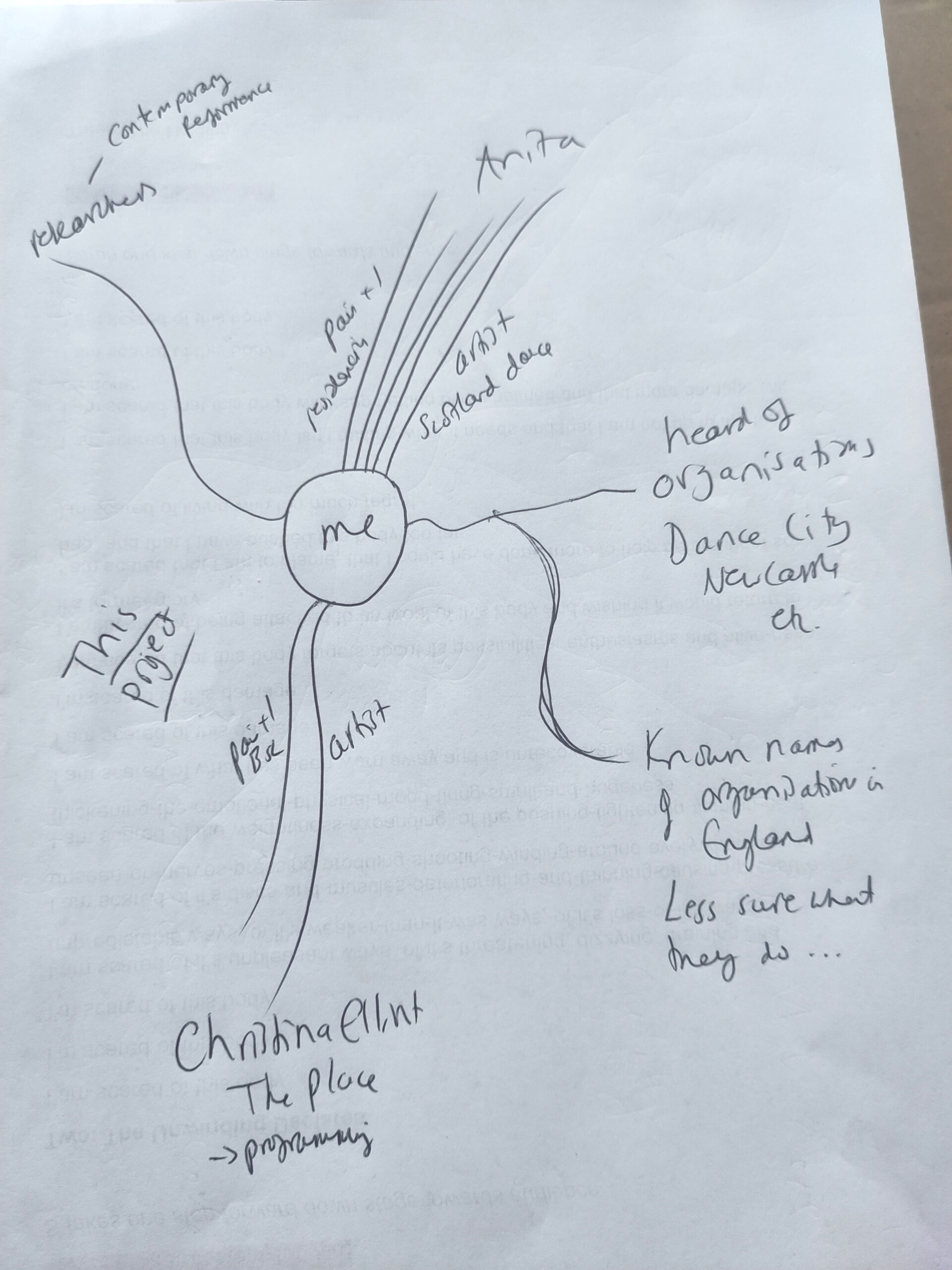
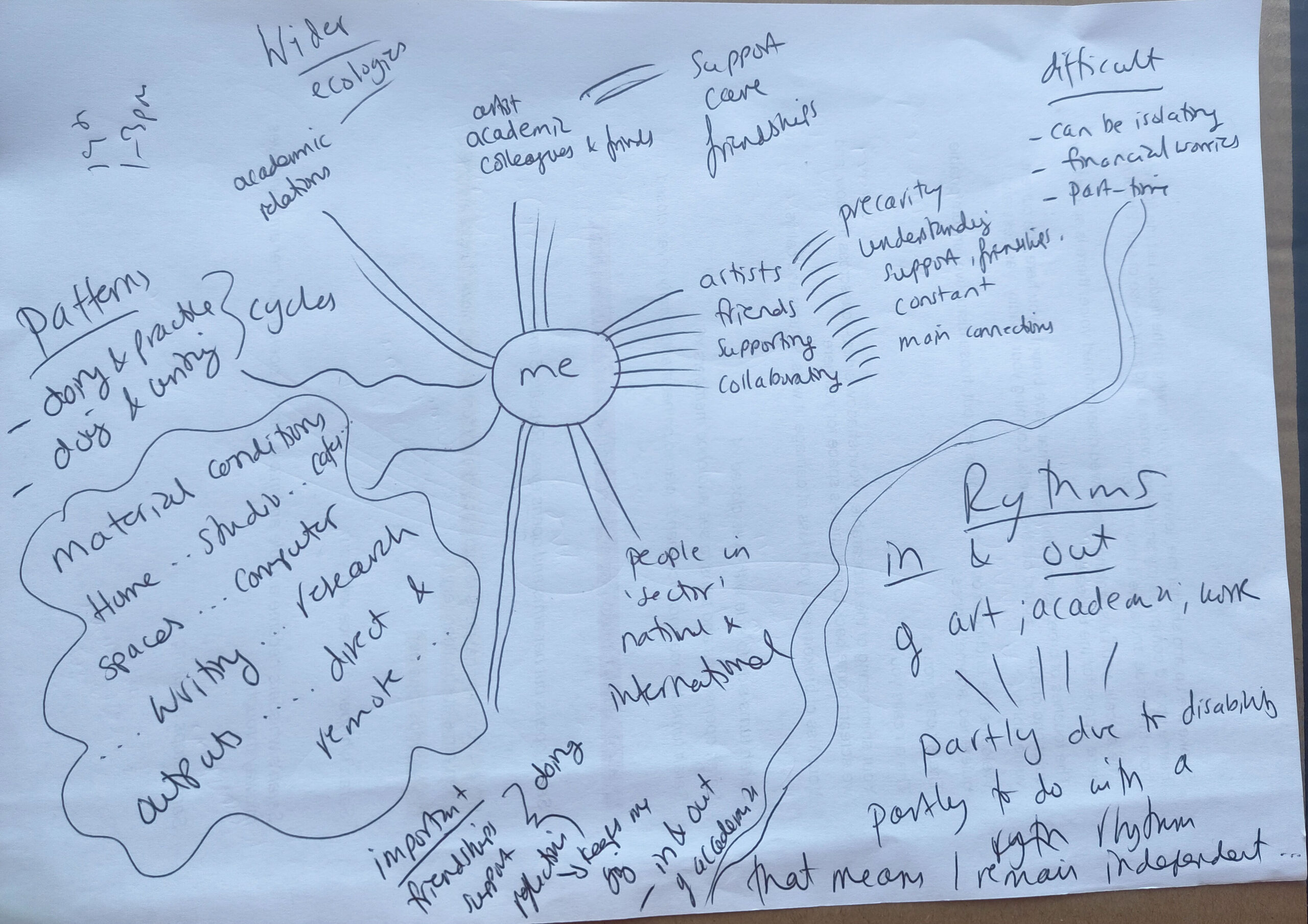
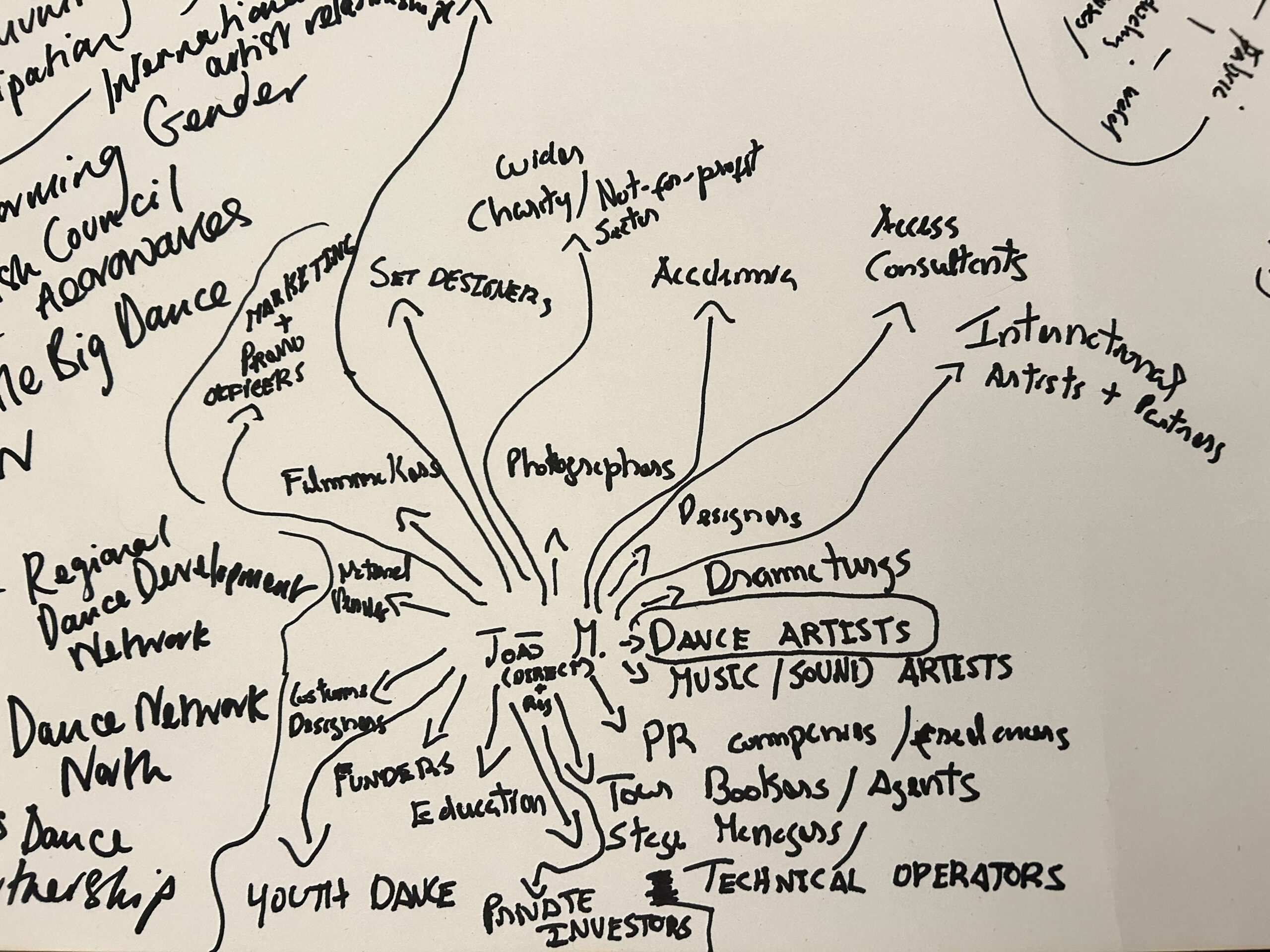
Words and images appear across large sheets of paper. Threads of connection, trees, plants and structures, columns and spirals, roads and maps.
roles (teacher, facilitator, researcher, producer)
activities (from performing, to making, to teaching, to producing, to shows, to touring), different types of practice (somatic, film, yoga, coaching),
venues and institutions (school, arts, galleries, HEI’s, NHS),
funders, communities and participants, research, collaborating,
working with partners and networking, commissions and funders.
Webs meshed and intertwined – patterns that allow a dance artist to exist in patterns that strive toward healthy balance and for self-care, yet these ideals sit in contrast to the striving to access resources to live, to dance, to facilitate creative practices in meaningful and sustainable ways.
I wonder when listening about how metaphors are. The landscape feels like a desert – but like all deserts a rich life is still present, even if often hidden, specialised and adaptive to the environmental conditions.
Vida Midgelow
