
Producing Differently – The Raze Collective

A blog from the FE: PDN Early Career Group

By Josephine Leask

The Raze collective is a queer, artist-led organisation that nurtures and develops innovative performance in the UK.

Started in 2016, in response to the closure of LGBTQIA + venues, Raze was committed to supporting and providing creative spaces for queer artist communities in London. The organisation did this by creating opportunities for LGBTQIA+ performers and producers, as well as expanding audiences. Shaped by the artists it was set up to support, especially underrepresented performers of colour, Raze aims to be flexible, dynamic, shapeshifting and holistic in its approaches to artist development. The organisation, which has a board of trustees and an artist steering group, is run by a team of 4 producer/artists: director Lucy Hayhoe, access producer Gayathiri Kamalakanthan and co-creative producers Seyi Osibamowo and Fraser Buchanan. This core leadership team work from their Dalston office and devote a few days each week to Raze alongside their own careers. Although they don’t have a venue of their own, Raze collaborates with a number of queer venue partners around London, where they run workshops, performances and community events.

Speaking to co-creative producer and dance artist Fraser Buchanan, I was impressed to hear how effective the organisation has been in developing infrastructure for young artists as well as creating and expanding queer communities and understandings of queer dance, through the performances/events they present. In this respect, Raze is an excellent case study for future ecologies of dance and performance producing.

Reliant on project funding, Raze currently runs three different strands of focus: artist development, workforce development and community. The robust artist development programme includes professional workshops and labs for both early or mid-career artists where they can develop their creative work alongside guest artistic mentors as well as receiving production support and opportunities to show case work in progress. Community outreach is important to Raze and this is achieved by producing big, dazzling community events such as cabarets hosted by partner venues. The workforce support is provided through the Young Producers Club, which includes networking coffee mornings, traineeships and internships as well as a yearly queer arts symposium.

The Young Producers club, first piloted in 2022, focuses on developing tools and skills in all aspects of producing. With recent funding from Arts Council England (ACE) for the next two years, the club will run a 9-week programme starting in the summer. Participants, who are selected through a careful application process, will meet 1 night per week and learn about marketing, budgeting and funding, accessibility and queer producing. Delivered by Raze’s leadership team alongside guest producers, the programme provides participants with opportunities to visit other queer performance organisations and check out different models of producing. Finally, participants can put their producer skills into practice by working on the events and performances that Raze produces across venues and festivals in London.

The benefits of the programme surpass the 9 weeks, as Raze continues to support each group of young producers, offering them networking and job opportunities within the organisation. One recent example of this is a new paid QTIBPOC marketing traineeship which is intended to encourage artists of colour to pursue leadership roles in theatre, performance and dance. Raze’s aim with all its artist and producer schemes is to make sure participants have the tools and language to navigate their future careers.

The grass roots nature of RAZE is what makes it work. Fraser tell me that everyone involved in running the organisation learns about their roles through working as a collective. Jobs and opportunities therefore evolve organically within the organisation. The spaciousness of Raze allows them to prioritise mental health, a good work/life balance and positive relationships between all working within the organisation. This sounds like a productive future ecology.
Crip Ecologies of Producing Dance

By Dr Sarah Hopfinger

What kinds of ecologies of producing dance exist, and are emerging, when disability and crip are the focus?

How do crip ecologies influence practice and approaches to making and producing dance?

Crip* Ecologies of Producing Dance is a partnership between The Work Room (Anita Clark) and Royal Conservatoire of Scotland (Dr Sarah Hopfinger), as part of the Future Ecologies: Producing Dance Network supported through the AHRC Dance Research Matters programme. This is bringing together higher education institutions and dance organisations across the UK to scope the ecosystem that supports those involved in producing dance https://rescen.net/FEPDN/

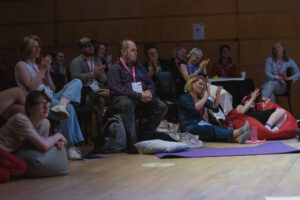
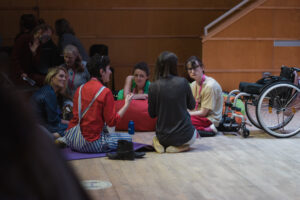
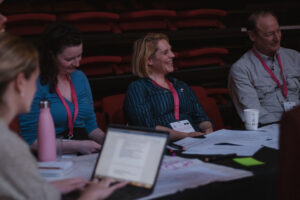
In September 2024 over forty disabled and non-disabled artists, producers, and researchers, whose work and interests relate to disability dance, came together to explore and share insights about crip ecologies of producing dance. This hybrid event included artist contributions from Dr Aby Watson, Laura Fisher, Salma Faraji and Claire Cunningham, which took the form of performance lectures and performance sharings. The event included creative prompts for conversation, roundtable discussions, informal conversation, spaces to rest and a quiet room. The aim was to embody care and inclusion through the form and structure of the day.
*Context and Crip
‘Crip’ is an identity, a politic, an activism, which some disabled individuals choose to identify with. It relates to the affirmative model of disability, which disabled scholars Nancy Hansen and Chris Philo discuss as ‘the normality of (different bodies) doing things differently’ (2007, 493). Drawing on the ethos of the disability arts movement and disability pride, crip is reclaimed from the derisive term ‘cripple’; a similar process of reclaiming language as used in queer activist and academic movements. Crip is a politicised view that challenges pity and deficit narratives of disability, refusing the configurations of disability as tragedy, dejection and loss. The affirmative model argues that an individual’s impairment is a crucial aspect of their identity and their place within disability or ‘crip’ culture. With crip, disability can be understood to offer rich creativity and knowledge. For disabled scholar Alison Kafer, crip refers to a ‘cripped politics of access and engagementʼ where to ‘say that something is “political” . . . means that it is implicated in relations of power and that those relations, their assumptions, and their effects are contested and contestable, open to dissent and debateʼ (2013, 3;9).

The following quote about ‘crip’ is from some collaborative research into dancing with chronic pain carried out by Dr Sarah Hopfinger and dance artist Raquel Mesequer Zafe,

I think about crip . . . [as] an idea, tool, a provocation . . . It feels different to . . . adapting myself to something, it feels bold, cheeky, playful, transgressive . . . If I am adapting, it’s like I’m still accepting that thing totally and I am asking to be different within it, whereas crip feels like it would say “well I’m not taking any of that, or I’m going to take it and take it this way because that is what is good and interesting for me” . . . [Crip has] energy and more possibilities [than adaptation or inclusion]. . . [Crip] doesn’t ask, it shakes up . . . takes space . . . I couldn’t give someone an instruction of what crip is because it is individual for all of us . . . It is widening the playing field . . . a different lens, a different paradigm, where things are assigned different value, where things I didn’t value before now have value or have the potential to have value.
Raquel Mesequer Zafe 2022.

If ecology is about relations and systems, with crip ecology we are interested in what kinds of relations and systems support – and do not support – producing crip and disability dance. What might crip dance practices, artistic forms, rehearsal structures, ways of touring, performer-audience relations etc, be?

What follows is a collection of questions, artist quotes, performance reflections, and images, gathered from the Crip Ecologies event – an ecology of ideas about crip ways of producing dance!

Prompts for roundtable discussions

What crip or disabled-led practices (of producing, of dance-making) do you have experience of, or know of?
What feels significant or important to you about crip?
How do crip ecologies influence practices of making dance?
How do crip ecologies influence approaches to producing dance?

What is difficult, what is easeful, for you in creating / producing dance?
What ways of working would make you want to repeatedly perform a work?
What producing practices would make you want to keep making dance happen?
What would be pleasurable?
How might future ecologies of crip producing in dance look, sound, taste, feel like?

Disordering Dance: Dr Aby Watson

Photo: Emily Nicholl

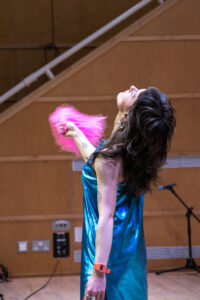
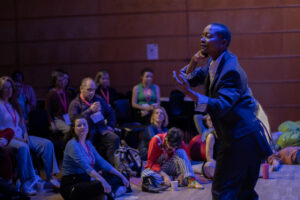
In this performance lecture, Aby explores neurodiversity as natural and creative, creating dance as ‘sensory process(ing), not as commodified product’. For Aby, ‘stimming is dancing and dancing is stimming’. She creates ‘radically relaxed performance’, which is when the show’s ‘relaxed nature is foundational to the work and creatively utilises the relaxed environment’.

I Hear You: Salma Faraji

Photo: Emily Nicholl

‘Am I too Old, too different, too vulnerable, too honest?’

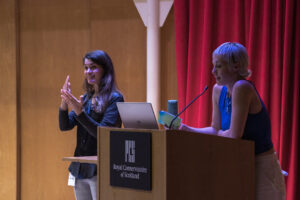
Salma asks the audience, in spoken English and in British Sign Language. We share in this performance – developed from the text from personal journals– charting her experiences of being visible different and standing out.
Leaning into signing, when unable to speak out – Salma brings to the performance a movement language which explores non-verbal communication, similarities within diverse context and seeks to challenge silence through portals of connection, empathy and shared vulnerability.
The performance– from Salma and accompanied by celloist Peter Nicolson – is full of spaciousness. It invites us, the audience, to imagine another’s experience and encourages us to practice empathy.

Strategies for Slowing Down: Laura Fisher

Photo: Emily Nicholl

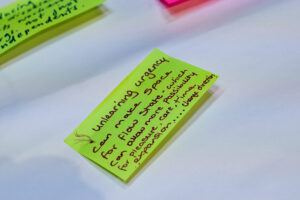
‘Slowing down is about unlearning urgency as the default’
‘What’s possible for all of us will be different’
‘The artistic possibilities of doing things differently’
‘Create change within the spheres of your influence’
‘Make plans generously, hold them lightly’
‘Whatever is possible today is enough’
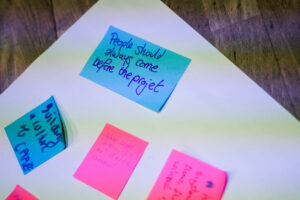
‘People should always come before the project’
‘Make rest precious’
‘A score for a sore and tired body’
‘Adaptable, scalable work’
‘Dramaturgies of rest and slowness’
‘Resist extractive ways of thinking’
‘Stop trying to always start from scratch’
‘What am I prepared to let go of?’
‘Where can I build on and support the work of others?’
‘What are my tools of soft resistance?’

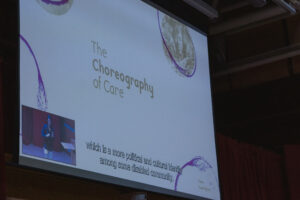
The Choreography of Care: Claire Cunningham

Photo: Emily Nicholl

‘The aesthetics of access – the practice of embedding access tools and strategies into performance making and staging’
‘Noticing what is difficult or easeful for disabled folks, and acting on it, as a form of care’
‘Design as Care…opening out to consider design of a project, design of a schedule, someone’s journey to rehearsal’
‘How might making it easy to leave be an act of care?’
‘Someone leaving could be a positive act’
‘Time as Care…giving time is important and may save time later’
‘Check-in time… giving attention and time…is not additional but is part of the work’
‘Communication as Care… recognise various ways and speeds of communicating’
‘Performance as Care… performing itself as an act of care’
‘What do I desire next, what would feed me, what would make want to repeatedly perform a work?’
‘Audience aftercare as part of the show, not additional’
‘The Complexity of Care…what happens when the needs and desires of some affect the needs and desires of others?’
‘Care takes many forms’

Hybrid Event – Re-imagining Making Dance Happen

The Future Ecologies: Producing Dance Network invites you to join this
 event on:

Tuesday, 18th February 2025  

12:00 noon – 5:00 PM GMT  

Online & in-person at: Dance City, Newcastle-upon-Tyne

This event is designed to tease out new models and understandings of producing dance, allowing a range of dance sector voices to be heard and for views to be exchanged. The focus is on how those involved in making dance happen can contribute to addressing current challenges by envisaging new ways of working that will ensure a better future for dance.

Re-imagining Dance begins with brief presentations from a panel, continues with a panel discussion and then opens to those present either in-person or online. The views expressed and new visions for dance presented will inform the FE:PDN Final Report.

Panellists include:

Louisa Borg-Costanzi Potts – Head of Programme, Artsadmin
Farooq Chaudhry – Dance Producer and Director
Suzie Leighton – Co-Director of National Centre for Academic and Cultural Exchange (NCACE)
Erin Sanchez – One Dance UK

Please book through Eventbrite to confirm in-person or online attendance:

In-Person Attendance

Online Attendance 

NCACE / FE:PDN Hybrid Workshop

January 15th 2025, 1pm-5pm

NCACE is partnering with Future Ecologies: Producing Dance Network (FE:PDN) and delivering this event to discuss and workshop some of the key themes and questions arising from the research to date. Drs Sarah Sigal and James Rowson of Royal Central School of Speech and Drama will present their recent research ‘Institutional Transformation: Growth and Change in Post-Pandemic Theatre’ and Kwesi Johnson, Creative Director of The Cultural Assembly and founder of Future Creatives will also join us.

Interested colleagues are warmly invited from across academia and the arts and cultural sector. We are particularly keen that those within the wider performing arts and humanities, arts and cultural and policy sectors beyond dance join the conversation.

Please note that this is a hybrid event, with tickets still available for online admission. Please select the appropriate ticket when booking.

Head to Eventbrite to reserve your place.

Hybrid Event – Producing Across Art Forms: Critical Practices for Equitable Ecologies  

The Future Ecologies: Producing Dance Network invites you to join this
 event on:

Tuesday, 14th January 2025  

2:00 PM – 6:00 PM GMT  

Online & In-person at:
University of the Arts London, 272 High Holborn London WC1V 7EY

Leading academics and practitioners share their insights and reflections on producing practices across art forms, including dance, visual arts and theatre. Elaborating praxis and sharing conversation, we aim to identify connections and distinctions across disciplines, with a focus on creating equitable and sustainable arts ecologies.

This event is part of the AHRC Future Ecologies: Producing Dance Network project, which brings together higher education institutions and dance organisations across the UK to scope the ecologies that enable dance to happen. This event seeks to develop discourses and methodologies around producing in dance, which is currently underrepresented in literature but rich in practice.

Key Themes: 

  1. Producing/curating as critical praxis across disciplines
  2. Producing/curating as a social practice for equitable ecologies
  3. Elaborating producing/curating as practice research 

Confirmed Contributors: 

Alison Green (University of the Arts London, Reader in Art, Curating and Culture)

Christina Elliot (The Place, Head of Programming & Producing)

Helen Brooks (University of the Arts London, Professor of Creative and Cultural History)

Jayne Thompson (University of Kent)

Nicole Haitzinger (Paris Lodron University in Salzburg, Professor of Dance Studies)

Gwendolin Lehnerer (Paris Lodron University in Salzburg, Dramaturg, Co-course Director)

Steffi Sachsenmaier (Middlesex University, Associate Professor in Contemporary Performance)

Treacle Holasz (Freelance producer and creative director)

We are thrilled to bring together such a remarkable group of presenters and hope you will join us in advancing these vital discussions as we together shape this discourse.

Please book through Eventbrite to confirm in-person or online attendance:

In-Person Attendance

Online Attendance 

Complete our Survey – Reimagining Producing: Making Dance Happen

Do you make dance happen? We want to hear from you!

Producers in organisations or independent, the subsidised or commercial sectors, self-producing artists, all those with a role in making dance happen – we want your voice be heard.

Complete the survey

Over 12 months the Future Ecologies: Producing Dance Network has investigated the producing dance ecosystem which extends across a wide range of those in dance and beyond. Through this blog we have shared some challenges facing this vital engine of the dance sector.

We have asked is dance producing hanging on, building back or reimagining itself? Now we need to hear from as many of you as possible.

Please take the survey so that your views inform recommendations for funders, policymakers and the dance sector to consider.

Complete it on or before the closing date 6th January 2025 to be submitted into a prize draw to win a £100 Marks and Spencer Voucher.