
Daylighting – By Lerna Babikyan

A blog from the FE: PDN Early Career Group

By Lerna Babikyan

Lerna Babikyan shares how engaging with the academia to produce her first performance in the UK served as a pivotal point in her journey as an artist.

Daylighting

My perception of and relationship with dance and performance have evolved significantly since graduating from a related bachelor’s program in Istanbul. Initially rooted in set movements and result-oriented dance performances, my practice expanded towards interdisciplinary improvisations, site-specific explorations in urban spaces, nature, and the profound ancient landscapes of the Aegean coastline. This journey became a process of unlearning and reflecting on a desire to broaden the scope of my performativity—once deeply intertwined with indigenous cultures—beyond the confines of the “black box” into alternative and traditional performance settings.

This exploration continued until the onset of the pandemic, which forced us into restricted movement and led to diverse bodily research within the domestic space. During this time, I revisited televised stage performances and encountered works by emerging choreographers with innovative stage designs. This rekindled my admiration for the stage, compelling me to reconnect with the stage while integrating my past experiences and future aspirations.

The seed of my idea was to create a participatory performance—one that dissolves the boundary between audience and performer, fostering a communicative space through movement, contact, expression, and collective creativity. My conceptual map was drawn from the displacement and misplacement story of my grandfather. Through performance, I sought to empathise with his emotions and efforts on making a new, unknown place home. Using my body and chalk, I traced lines of searching for belonging, while audience contributions transformed the space into a shared act of homing. This process of embodiment, collective memory, and reimagining mirrored a kind of daylighting—the act of bringing hidden narratives and histories back to visibility, much like reviving lost rivers.

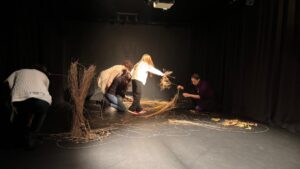
Cartographic Echoes became my first officially produced piece in England. Alongside my audience, I engaged with non-human bodies—bark, flax, dried leaves, and mosses on the stage. Moving with and through these elements, sensing their textures, scents, and forms, allowed my body to transform, deepening my ecosomatic awareness and expanding my sense of presence beyond natural environments. These organic materials reminded me of both the fragility and resilience in life, exposing the fluidity of time concept and our capacity to move beyond imposed linearity of it. They echoed the long-standing companionship between humans and plants, reinforcing a profound connection to the natural world. Through this performance, I was able to write and rewrite my grandfather’s story—alongside countless other shared narratives of displacement—stories that remain timeless and universal.

Last but not least, I want to express my deep gratitude to the collaborative environment provided by Schumacher College, Dartington Arts, and Plymouth University. The convergence of academic insight merged with artistry, holistic philosophy, and ecological awareness created fertile ground for my research and for the realization of this daylighting experience. Under the guidance of Dr. Rachel Sweeney, I was encouraged to access and trust the authentic layers of my creative self—particularly those tied to my cultural memory and mother tongue. Sensing the inclusive atmosphere through her mentorship not only created a safe and rigorous space for exploration, but also helped me understand how my voice could emerge with greater clarity and confidence, free from external expectations or the need to translate myself into other frameworks.

Finally, this performance, and the process of developing it, became a pivotal point in my journey as an artist. It expanded my perception of the stage as a living site for dialogue, remembering, and transformation. This experience didn’t just add to my artistic toolkit—it also empowered me to move forward with deeper integrity, resilience, and rootedness in body, story and ability to go beyond the stories by multiplied ways of applied research and performance.
Producing Differently – The Raze Collective

A blog from the FE: PDN Early Career Group

By Josephine Leask

The Raze collective is a queer, artist-led organisation that nurtures and develops innovative performance in the UK.

Started in 2016, in response to the closure of LGBTQIA + venues, Raze was committed to supporting and providing creative spaces for queer artist communities in London. The organisation did this by creating opportunities for LGBTQIA+ performers and producers, as well as expanding audiences. Shaped by the artists it was set up to support, especially underrepresented performers of colour, Raze aims to be flexible, dynamic, shapeshifting and holistic in its approaches to artist development. The organisation, which has a board of trustees and an artist steering group, is run by a team of 4 producer/artists: director Lucy Hayhoe, access producer Gayathiri Kamalakanthan and co-creative producers Seyi Osibamowo and Fraser Buchanan. This core leadership team work from their Dalston office and devote a few days each week to Raze alongside their own careers. Although they don’t have a venue of their own, Raze collaborates with a number of queer venue partners around London, where they run workshops, performances and community events.

Speaking to co-creative producer and dance artist Fraser Buchanan, I was impressed to hear how effective the organisation has been in developing infrastructure for young artists as well as creating and expanding queer communities and understandings of queer dance, through the performances/events they present. In this respect, Raze is an excellent case study for future ecologies of dance and performance producing.

Reliant on project funding, Raze currently runs three different strands of focus: artist development, workforce development and community. The robust artist development programme includes professional workshops and labs for both early or mid-career artists where they can develop their creative work alongside guest artistic mentors as well as receiving production support and opportunities to show case work in progress. Community outreach is important to Raze and this is achieved by producing big, dazzling community events such as cabarets hosted by partner venues. The workforce support is provided through the Young Producers Club, which includes networking coffee mornings, traineeships and internships as well as a yearly queer arts symposium.

The Young Producers club, first piloted in 2022, focuses on developing tools and skills in all aspects of producing. With recent funding from Arts Council England (ACE) for the next two years, the club will run a 9-week programme starting in the summer. Participants, who are selected through a careful application process, will meet 1 night per week and learn about marketing, budgeting and funding, accessibility and queer producing. Delivered by Raze’s leadership team alongside guest producers, the programme provides participants with opportunities to visit other queer performance organisations and check out different models of producing. Finally, participants can put their producer skills into practice by working on the events and performances that Raze produces across venues and festivals in London.

The benefits of the programme surpass the 9 weeks, as Raze continues to support each group of young producers, offering them networking and job opportunities within the organisation. One recent example of this is a new paid QTIBPOC marketing traineeship which is intended to encourage artists of colour to pursue leadership roles in theatre, performance and dance. Raze’s aim with all its artist and producer schemes is to make sure participants have the tools and language to navigate their future careers.

The grass roots nature of RAZE is what makes it work. Fraser tell me that everyone involved in running the organisation learns about their roles through working as a collective. Jobs and opportunities therefore evolve organically within the organisation. The spaciousness of Raze allows them to prioritise mental health, a good work/life balance and positive relationships between all working within the organisation. This sounds like a productive future ecology.

Crip Ecologies of Producing Dance

By Dr Sarah Hopfinger

What kinds of ecologies of producing dance exist, and are emerging, when disability and crip are the focus?

How do crip ecologies influence practice and approaches to making and producing dance?

Crip* Ecologies of Producing Dance is a partnership between The Work Room (Anita Clark) and Royal Conservatoire of Scotland (Dr Sarah Hopfinger), as part of the Future Ecologies: Producing Dance Network supported through the AHRC Dance Research Matters programme. This is bringing together higher education institutions and dance organisations across the UK to scope the ecosystem that supports those involved in producing dance https://rescen.net/FEPDN/

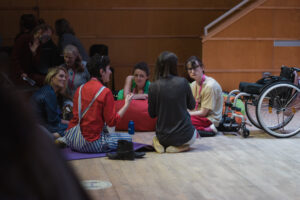
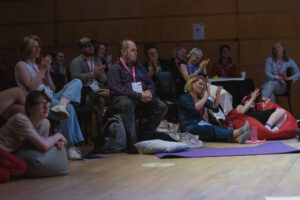
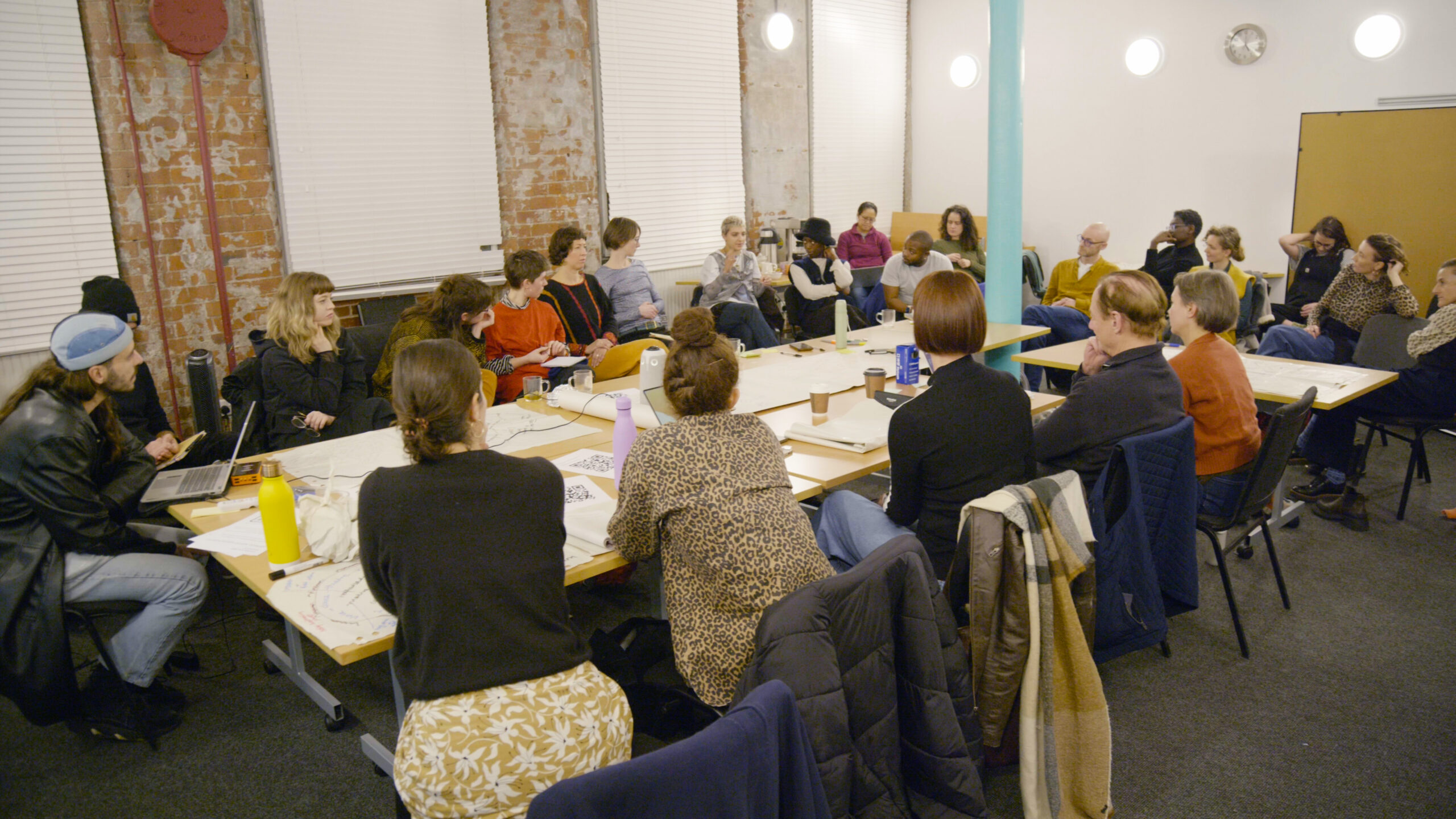
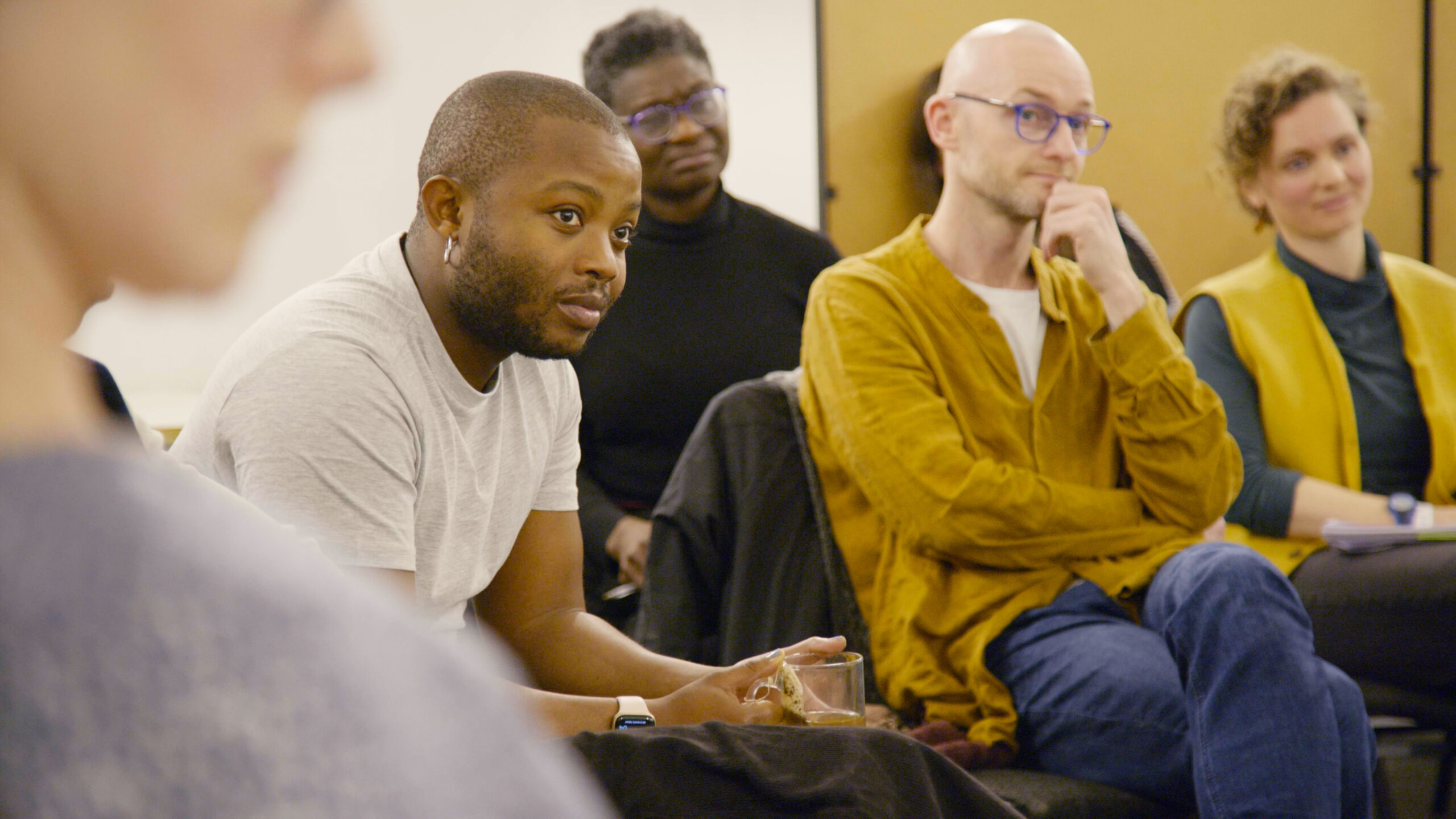
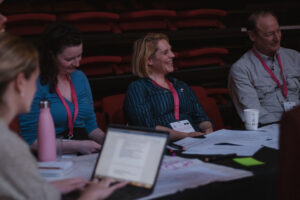
In September 2024 over forty disabled and non-disabled artists, producers, and researchers, whose work and interests relate to disability dance, came together to explore and share insights about crip ecologies of producing dance. This hybrid event included artist contributions from Dr Aby Watson, Laura Fisher, Salma Faraji and Claire Cunningham, which took the form of performance lectures and performance sharings. The event included creative prompts for conversation, roundtable discussions, informal conversation, spaces to rest and a quiet room. The aim was to embody care and inclusion through the form and structure of the day.
*Context and Crip
‘Crip’ is an identity, a politic, an activism, which some disabled individuals choose to identify with. It relates to the affirmative model of disability, which disabled scholars Nancy Hansen and Chris Philo discuss as ‘the normality of (different bodies) doing things differently’ (2007, 493). Drawing on the ethos of the disability arts movement and disability pride, crip is reclaimed from the derisive term ‘cripple’; a similar process of reclaiming language as used in queer activist and academic movements. Crip is a politicised view that challenges pity and deficit narratives of disability, refusing the configurations of disability as tragedy, dejection and loss. The affirmative model argues that an individual’s impairment is a crucial aspect of their identity and their place within disability or ‘crip’ culture. With crip, disability can be understood to offer rich creativity and knowledge. For disabled scholar Alison Kafer, crip refers to a ‘cripped politics of access and engagementʼ where to ‘say that something is “political” . . . means that it is implicated in relations of power and that those relations, their assumptions, and their effects are contested and contestable, open to dissent and debateʼ (2013, 3;9).

The following quote about ‘crip’ is from some collaborative research into dancing with chronic pain carried out by Dr Sarah Hopfinger and dance artist Raquel Mesequer Zafe,

I think about crip . . . [as] an idea, tool, a provocation . . . It feels different to . . . adapting myself to something, it feels bold, cheeky, playful, transgressive . . . If I am adapting, it’s like I’m still accepting that thing totally and I am asking to be different within it, whereas crip feels like it would say “well I’m not taking any of that, or I’m going to take it and take it this way because that is what is good and interesting for me” . . . [Crip has] energy and more possibilities [than adaptation or inclusion]. . . [Crip] doesn’t ask, it shakes up . . . takes space . . . I couldn’t give someone an instruction of what crip is because it is individual for all of us . . . It is widening the playing field . . . a different lens, a different paradigm, where things are assigned different value, where things I didn’t value before now have value or have the potential to have value.
Raquel Mesequer Zafe 2022.

If ecology is about relations and systems, with crip ecology we are interested in what kinds of relations and systems support – and do not support – producing crip and disability dance. What might crip dance practices, artistic forms, rehearsal structures, ways of touring, performer-audience relations etc, be?

What follows is a collection of questions, artist quotes, performance reflections, and images, gathered from the Crip Ecologies event – an ecology of ideas about crip ways of producing dance!

Prompts for roundtable discussions

What crip or disabled-led practices (of producing, of dance-making) do you have experience of, or know of?
What feels significant or important to you about crip?
How do crip ecologies influence practices of making dance?
How do crip ecologies influence approaches to producing dance?

What is difficult, what is easeful, for you in creating / producing dance?
What ways of working would make you want to repeatedly perform a work?
What producing practices would make you want to keep making dance happen?
What would be pleasurable?
How might future ecologies of crip producing in dance look, sound, taste, feel like?

Disordering Dance: Dr Aby Watson

Photo: Emily Nicholl

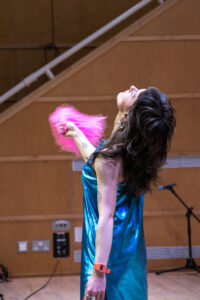
In this performance lecture, Aby explores neurodiversity as natural and creative, creating dance as ‘sensory process(ing), not as commodified product’. For Aby, ‘stimming is dancing and dancing is stimming’. She creates ‘radically relaxed performance’, which is when the show’s ‘relaxed nature is foundational to the work and creatively utilises the relaxed environment’.

I Hear You: Salma Faraji

Photo: Emily Nicholl

‘Am I too Old, too different, too vulnerable, too honest?’

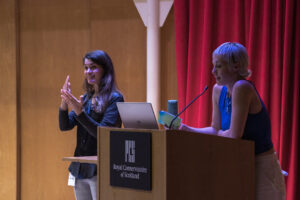
Salma asks the audience, in spoken English and in British Sign Language. We share in this performance – developed from the text from personal journals– charting her experiences of being visible different and standing out.
Leaning into signing, when unable to speak out – Salma brings to the performance a movement language which explores non-verbal communication, similarities within diverse context and seeks to challenge silence through portals of connection, empathy and shared vulnerability.
The performance– from Salma and accompanied by celloist Peter Nicolson – is full of spaciousness. It invites us, the audience, to imagine another’s experience and encourages us to practice empathy.

Strategies for Slowing Down: Laura Fisher

Photo: Emily Nicholl

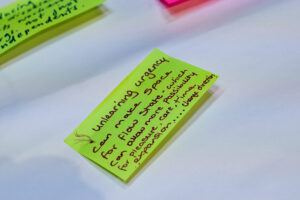
‘Slowing down is about unlearning urgency as the default’
‘What’s possible for all of us will be different’
‘The artistic possibilities of doing things differently’
‘Create change within the spheres of your influence’
‘Make plans generously, hold them lightly’
‘Whatever is possible today is enough’
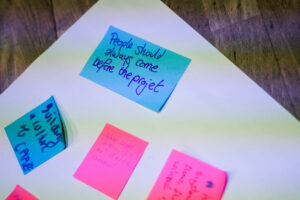
‘People should always come before the project’
‘Make rest precious’
‘A score for a sore and tired body’
‘Adaptable, scalable work’
‘Dramaturgies of rest and slowness’
‘Resist extractive ways of thinking’
‘Stop trying to always start from scratch’
‘What am I prepared to let go of?’
‘Where can I build on and support the work of others?’
‘What are my tools of soft resistance?’

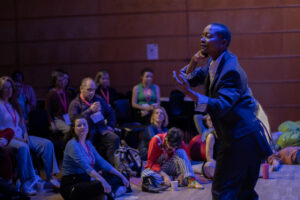
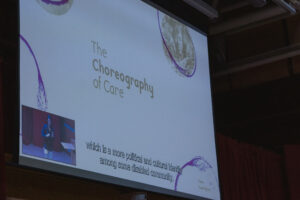
The Choreography of Care: Claire Cunningham

Photo: Emily Nicholl

‘The aesthetics of access – the practice of embedding access tools and strategies into performance making and staging’
‘Noticing what is difficult or easeful for disabled folks, and acting on it, as a form of care’
‘Design as Care…opening out to consider design of a project, design of a schedule, someone’s journey to rehearsal’
‘How might making it easy to leave be an act of care?’
‘Someone leaving could be a positive act’
‘Time as Care…giving time is important and may save time later’
‘Check-in time… giving attention and time…is not additional but is part of the work’
‘Communication as Care… recognise various ways and speeds of communicating’
‘Performance as Care… performing itself as an act of care’
‘What do I desire next, what would feed me, what would make want to repeatedly perform a work?’
‘Audience aftercare as part of the show, not additional’
‘The Complexity of Care…what happens when the needs and desires of some affect the needs and desires of others?’
‘Care takes many forms’

Hybrid Event – Re-imagining Making Dance Happen

The Future Ecologies: Producing Dance Network invites you to join this
 event on:

Tuesday, 18th February 2025  

12:00 noon – 5:00 PM GMT  

Online & in-person at: Dance City, Newcastle-upon-Tyne

This event is designed to tease out new models and understandings of producing dance, allowing a range of dance sector voices to be heard and for views to be exchanged. The focus is on how those involved in making dance happen can contribute to addressing current challenges by envisaging new ways of working that will ensure a better future for dance.

Re-imagining Dance begins with brief presentations from a panel, continues with a panel discussion and then opens to those present either in-person or online. The views expressed and new visions for dance presented will inform the FE:PDN Final Report.

Panellists include:

Louisa Borg-Costanzi Potts – Head of Programme, Artsadmin
Farooq Chaudhry – Dance Producer and Director
Suzie Leighton – Co-Director of National Centre for Academic and Cultural Exchange (NCACE)
Erin Sanchez – One Dance UK

Please book through Eventbrite to confirm in-person or online attendance:

In-Person Attendance

Online Attendance 

NCACE / FE:PDN Hybrid Workshop

January 15th 2025, 1pm-5pm

NCACE is partnering with Future Ecologies: Producing Dance Network (FE:PDN) and delivering this event to discuss and workshop some of the key themes and questions arising from the research to date. Drs Sarah Sigal and James Rowson of Royal Central School of Speech and Drama will present their recent research ‘Institutional Transformation: Growth and Change in Post-Pandemic Theatre’ and Kwesi Johnson, Creative Director of The Cultural Assembly and founder of Future Creatives will also join us.

Interested colleagues are warmly invited from across academia and the arts and cultural sector. We are particularly keen that those within the wider performing arts and humanities, arts and cultural and policy sectors beyond dance join the conversation.

Please note that this is a hybrid event, with tickets still available for online admission. Please select the appropriate ticket when booking.

Head to Eventbrite to reserve your place.

Hybrid Event – Producing Across Art Forms: Critical Practices for Equitable Ecologies  

The Future Ecologies: Producing Dance Network invites you to join this
 event on:

Tuesday, 14th January 2025  

2:00 PM – 6:00 PM GMT  

Online & In-person at:
University of the Arts London, 272 High Holborn London WC1V 7EY

Leading academics and practitioners share their insights and reflections on producing practices across art forms, including dance, visual arts and theatre. Elaborating praxis and sharing conversation, we aim to identify connections and distinctions across disciplines, with a focus on creating equitable and sustainable arts ecologies.

This event is part of the AHRC Future Ecologies: Producing Dance Network project, which brings together higher education institutions and dance organisations across the UK to scope the ecologies that enable dance to happen. This event seeks to develop discourses and methodologies around producing in dance, which is currently underrepresented in literature but rich in practice.

Key Themes: 

  1. Producing/curating as critical praxis across disciplines
  2. Producing/curating as a social practice for equitable ecologies
  3. Elaborating producing/curating as practice research 

Confirmed Contributors: 

Alison Green (University of the Arts London, Reader in Art, Curating and Culture)

Christina Elliot (The Place, Head of Programming & Producing)

Helen Brooks (University of the Arts London, Professor of Creative and Cultural History)

Jayne Thompson (University of Kent)

Nicole Haitzinger (Paris Lodron University in Salzburg, Professor of Dance Studies)

Gwendolin Lehnerer (Paris Lodron University in Salzburg, Dramaturg, Co-course Director)

Steffi Sachsenmaier (Middlesex University, Associate Professor in Contemporary Performance)

Treacle Holasz (Freelance producer and creative director)

We are thrilled to bring together such a remarkable group of presenters and hope you will join us in advancing these vital discussions as we together shape this discourse.

Please book through Eventbrite to confirm in-person or online attendance:

In-Person Attendance

Online Attendance 

Complete our Survey – Reimagining Producing: Making Dance Happen

Do you make dance happen? We want to hear from you!

Producers in organisations or independent, the subsidised or commercial sectors, self-producing artists, all those with a role in making dance happen – we want your voice be heard.

Complete the survey

Over 12 months the Future Ecologies: Producing Dance Network has investigated the producing dance ecosystem which extends across a wide range of those in dance and beyond. Through this blog we have shared some challenges facing this vital engine of the dance sector.

We have asked is dance producing hanging on, building back or reimagining itself? Now we need to hear from as many of you as possible.

Please take the survey so that your views inform recommendations for funders, policymakers and the dance sector to consider.

Complete it on or before the closing date 6th January 2025 to be submitted into a prize draw to win a £100 Marks and Spencer Voucher.

Crip* Ecologies of Producing Dance

Thursday 19 September
12 – 5.30 pm (Including lunch)
Royal Conservatoire of Scotland (and also online)

Dr. Aby Watson: Back & Forth & Forth & back photo by Tiu Makkonen

A partnership between The Work Room and Royal Conservatoire of Scotland, this event is part of the AHRC Future Ecologies: Producing Dance Network project, which brings together higher education institutions and dance organisations across the UK to scope the ecosystem that supports those involved in producing dance.

We invite disabled and non-disabled artists, producers, researchers, and anyone interested exploring alternative models of producing dance to join us either in person or on-line.

• What kinds of ecologies of producing dance exist, and are emerging, when disability and crip are the focus?
• How do crip ecologies influence practice and approaches to making and producing dance?
• What crip models of producing are currently being practiced?
• What might future ecologies of crip producing look / sound / feel like?

With crip, different ways of knowing, experiencing, and doing, are embraced. The emphasis is on the normality of different bodyminds doing things differently. Crip relates to the affirmative model of disability and has emerged from disability arts and disability pride. An activist term and politicised identity, crip embraces an individual’s impairment as a crucial aspect of their identity and place within disability or crip culture.

If ecology is about relations and systems, with crip ecology we are interested in what kinds of relations and systems support producing crip and disability dance. Are there particular kinds of relations between those involved in producing dance that emerge in the context of crip? What are crip dance practices, artistic forms, rehearsal structures, ways of touring, performer-audience relations etc? And how do crip approaches influence and relate more widely to current ecosystems of producing dance?

Crip Ecologies of Producing Dance will be a relaxed, creative and accessible event with artists presentations, discussions and reflections. The event will be hosted by Dr Sarah Hopfinger (RCS) and Anita Clark (The Work Room) with guest contributions:

Dr Aby Watson
Laura Fisher
Salma Faraji

It is open to anyone interested in contributing to these conversations around crip dance producing.

To register for this event and for further details, please click here.

* Many self-identifying disabled people, particularly in arts and activism, have reclaimed ‘Crip’ as a political term of solidarity, community and resistance to able-ism; conveying shared understanding, celebration and appreciation of what it is to live in the world as a disabled person. This is the intention with which we use it here. We know that not all disabled people embrace this term. You are very much welcome to this event if you are a disabled person who does not identify with the term.

Producing Dance Forum – 7th June FABRIC Birmingham!

Hello colleagues, I am leading a research network project funded by the Arts and Humanities Research Council scoping the state of the ecosystem that has supported/is supporting those involved in producing dance.

AHRC-funded Future Ecologies: Producing Dance Network

From 1.30-5.30 on 7th June we will be working with FABRIC in-person and online at the Dance Hub Birmingham.

Presenters
Raidene Carter – Artistic Director artsadmin
Mark Mallabone – Creative Producer Freelance
Genevieve Say – Artistic Director Birmingham Dance Network

We need your presence and your input to inform and shape our work! Advance sign-up via this form.

In-Person: 12.30-1.30 Arrivals and lunch – 1.30-5.30 as below

Online: 1:30-5.30 Presentations and Interactive Sessions

AHRC Investigators

‘Funmi Adewole, Co-Investigator, De Montfort University
Christopher Bannerman, Principal Investigator, London Contemporary Dance School
Sarah Hopfinger, Co-Investigator, Royal Conservatoire of Scotland
Rachel Krische, Co-Investigator, Leeds Beckett University
Vida Midgelow, Co-Investigator, University of the Arts London
Stefanie Sachsenmaier, Co-Investigator, Middlesex University

Arts Partners

Anand Bhatt, CEO/Artistic Director, Dance City
Anita Clark, Director, The Work Room
Andrew Hurst, Chief Executive, One Dance UK
Suzie Leighton, Co-Director, The Culture Capital Exchange
Eddie Nixon, Artistic Director, The Place
Efrosini Protopapa, Director PG Courses & Research, LCDS
Hannah Robertshaw, Creative Director, Yorkshire Dance
Paul Russ, CEO/Artistic Director, Fabric

Funded through AHRC Award AH/Y002334/1
Developed by Christopher Bannerman, Vida Midgelow and Steffi Sachsenmaier

Hold the date!

In partnership with FABRIC and Birmingham Dance Network the next FE:PDN hybrid event will take place on Friday 7 June at the Dance Hub space, Thorp Street, Birmingham. This is less than a 10 min walk from New Street Station. Parking is available (at a charge locally).

Further Information to be provided soon for attendance online.

Provisional Schedule

12:30–5:00pm

Arrivals and lunch 12:30–1:30

1:30 Welcome – framing of the project and the event – introductions
1:45 First course
2:25 Break
2:35 Second course
3:05 Break
3:15 Third course
3:55 Break
4:05 Final course
4:45 Wrap-up
5:00 Close

Reflections on the Future Ecologies, Artist Forum at Yorkshire Dance

1. Tomorrow is about being in listening mode …

This was one of the actions at the front of my mind, identified in our Future Ecologies network group meeting the day before joining the invited freelance dance artists, working at the coalface of dance practice in West Yorkshire.

Vida, Chris and Steffi created a structure where they facilitated the recalling, mapping, reflection, conversation and an exchange of experience and ideas that lived under the focus of eco-systems – Vida’s blog post below clearly articulates the intention, structure and questions/method used on the day. In the first half of the day, the Future Ecologies team, in a way, test ran the tasks. It was no surprise to me when mapping our team’s eco-system, that the vast web of our professional and personal lives of course intersected and interwove, regardless of the many roles we have inhabited – let’s be honest, the contemporary dance world isn’t super huge – but it set a base for the conversation that followed. What was most interesting for me, was the notion that arose of ‘eco-system-engineering’ – that organisms can create their environments, such as an earthworm enriching their soil. It was an attractive metaphor. Could we begin to think that ‘engineering’ the environment of dance practice/production through (a more expanded understanding or version of) producing, was possible? a potential option? And how might that look/operate/be?

As a co-investigator on this project, at this point in full time employment at Leeds Beckett University, I had many questions that the project brief had provoked on the area of producing in relation to sustainability. Questions that for me had to also include broader economic and political consideration. At this early point in the day, I was reminded of what I often feel when I am with my students. I recognise that 32 years ago, even though I had always struggled financially, as an always employed, freelance dance artist (this drove me to seek a job in Higher Education), I knew that these early years in the 1990’s were halcyon days compared to now. Though it was enjoyable to reminisce about our interweaving professional and personal lives, most of us were speaking right now from the privileged positions of being salaried – we are ‘professional researchers’, which in some respects means that we are paid to conceptualise.

2. It is important to be transparent about what the actual lived ecology is, rather than what, a conceptual (often idealised) ecology is …

So, what is this lived ecology, right now, in post-covid, cost-of-living, Brexit Britain?
The guest freelance artists could easily respond to the eco-system mapping task – picking up a marker pen and making visible on paper diagrams of webs of personal and professional connections, artistic practices, roles, geographical locations, buildings, institutions, organisations, dance jobs and side hustles. Many are self-producing. They were honest, open, caring, invested, pragmatic, generous .. … and humorous …

‘Life is a funding bid’

kicked off the laughter as well as the discussion. And so, in the interests of transparency about lived experience, the following, extracted from the whole group conversation after the exercise of putting marker pen to paper, has particularly stayed with me:

‘I spend a lot of time looking for resources rather than actually doing the art’
‘I am overwhelmed by the sheer amount of things that I have to do’
‘Choice has been replaced with survival’
‘My geographical area has become my eco-system – geographical proximity makes my artistic practice viable but, I do not make a living out of making art’
‘Maybe my art should be a hobby – the utopian ideal, because it is artmaking without conditions’
‘Imagine if we stopped’

Still?
And I repeat – I recognise that 32 years ago, even though I had always struggled financially, as an always employed, freelance dance artist …… these were halcyon days compared to now.
I shall admit here that I felt utterly sad and depressed about the state that we (our sector), are still in. A surefire solution in my mind would be another utopian ideal – UNIVERSAL BASIC INCOME.

But, what really broke my heart was the following:

‘I know that ‘art’ is at the bottom of broader societal concerns. And dance is at the bottom of ‘art’. And community dance – what I practice – well, that is at the bottom of dance.’

This was then countered with something along the lines of:

‘But I start the day thinking this, then I go and spend 2 hours in the evening with my community group and return home feeling fulfilled and inspired and in love with what I do and in no doubt that it matters’

It was clear that an ecology exists and that these artists lived their current ecologies. And that these lived ecologies also involved positioning within a field of perceived respect, as well as different power structures that dictate the circumstances of their lives, their bank balance, their housing, their health and their mental health more broadly. Therefore, how can we create the conditions to ‘engineer’ a different, more equitable, more sustainable eco-system? What might that look like and how can we do it? What is sustainability in action? Can ‘recovery’ be built into this? How can producing develop and support this? What form does/can producing take to develop and support this?

3. Ecological adaptation …

Building stronger relationships between Higher Education, seen as a secure and robust area, and the professional, freelance sector of dance practice, was a prominent feature that I understood to be underpinning this Future Ecologies Project when it was written – hence my involvement as co-investigator, because I was also tied to a university. But at the time of this first forum, notions of resilience from ‘joining forces’, were already beginning to seriously wobble in my own experience. Although at that time still under wraps, dance was literally beginning to be dismantled at my own institution. We were not the only ones. Dance provision in HE was (and is) toppling like dominoes around the country. The part we play, our ‘producing’ role in the web of providing both a broad dance education and the side-hustle, part-time jobs for dance artists, is fast disappearing. The irony of the timing of this project has not escaped me as I take Voluntary Severance.

My own professional history has included 18 years of freelance practice prior to being registered on an institution’s payroll. Even after 15 years in HE, I never once, in all that time, presumed my future was safe or assured – the freelance experience leaves a deep, ingrained, psychological mark. Perhaps the mark is actually one of resilience anyway, after all, I did manage to somehow get this far. I leave this project as the representative of Leeds Beckett University, but I remain with this project as an independent artist. The job of thinking about re-creating or re-engineering our producing environment, in order to help figure out what a future dance ecology might be, is no doubt timely. Doing it comes next. Ecological thinking and a resulting evolving ecology, in communication with its environment, fundamentally involves adaptation … which of course we do well … and is always about movement.

18 January FE:PDN Meeting

At this meeting of the network we began to share and discuss the experiences of producing dance and how they have, or might in future, intersect with HE. Anecdotally there is copious evidence of such links but they tend to be personal-professional and ‘below the radar’ of dance as an academic discipline; so one key aim of the FE:PDN project is to extend the range of dance in HE so that it encompasses the people, processes and products of producing. As we prepared the AHRC application that is supporting the network, the literature review revealed just how bare the cupboard is in relation to research related to dance and producing – we hope to begin to address that gap in our work.

Another related aim is to develop a better understanding of the dance ecosystem, how it functions and its current state in these unstable and challenging times. Both aims informed this day as we begin to gather the views and reflections of a group of leaders of dance organisations spread geographically but with UK and international networks. Steffi Sachsenmaier led the session and captured some of the discussion using online padlets.

Considering Ecosystems

I’ve often wondered how things can exist outside of an ecosystem… doesn’t everything need connections, relationships and diversity to thrive? Having worked in dance for over 20 years, I have become part of an ecosystem, one in which I’ve had many roles, built many relationships and developed many partnerships. Now leading a dance organisation, I know that it’s nearly impossible to remove one thing and it NOT have impact on everything else. This is true of, but not limited to, projects, people, spaces, funding, roles and programmes of work.

The current strain on the ecosystem is a direct result of diminishing resources, where the loss of say, an undergraduate dance course, has a direct impact on the local dance ecology in relation to workforce development, which then has a direct impact on project delivery and artistic development which then has a direct impact on producing roles, programmers and audiences. Put simply, if you remove one thing from the ecosystem, there is potential collapse.

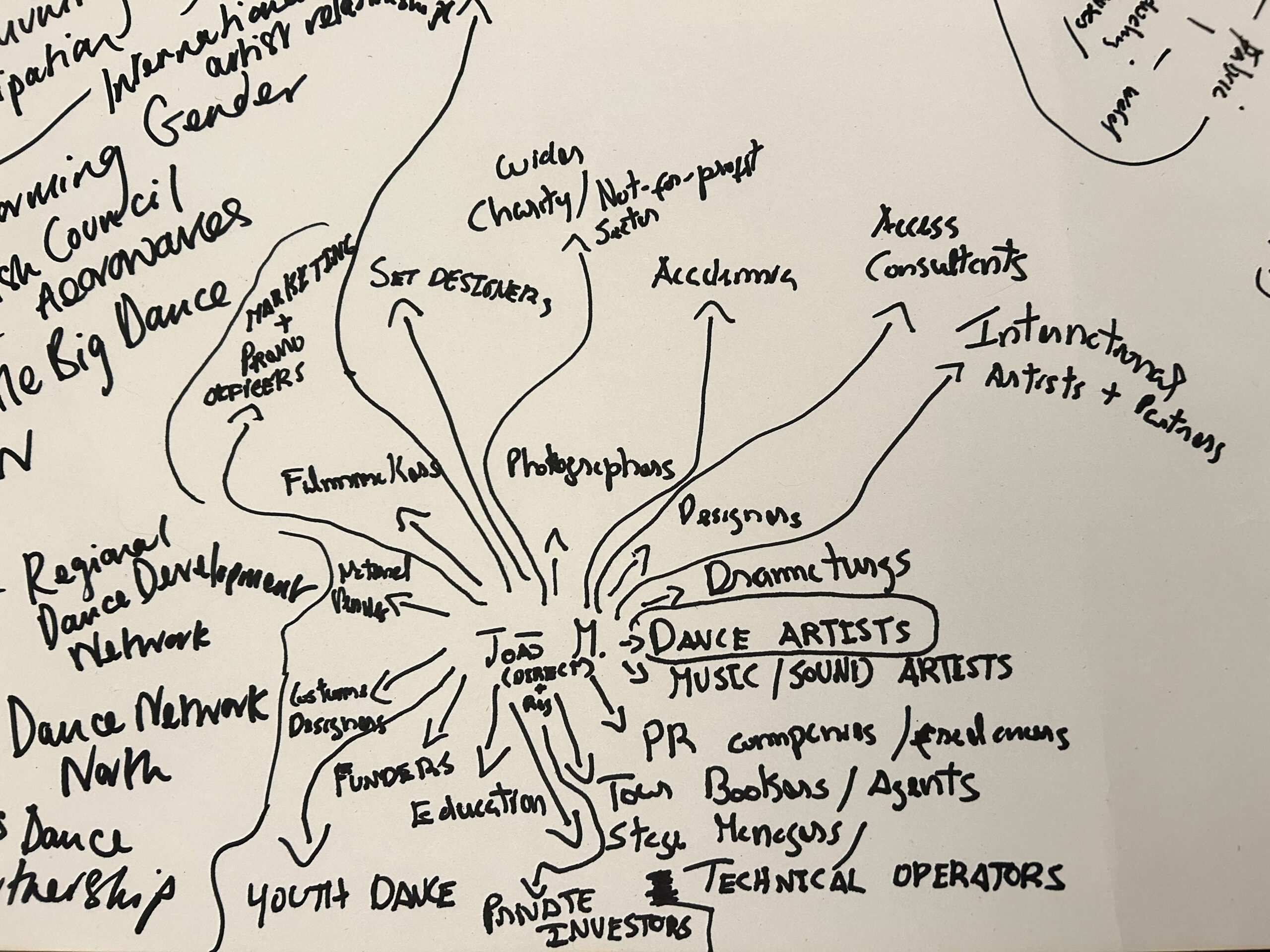
So what does a robust ecosystem look like and what does this look like for dance? Within the Producing Ecologies network, it’s clear that the dance ecosystem seems vast. From a simple mapping task of relationships, a complex web of people, places, events, projects and collaboration emerged. Amongst this lots of co-dependencies were described – ‘when I ran the space that you were in residency in’, ‘when you fundraised for the project I led’, ‘when we collaborated on research’, ‘when you employed me’, ‘when we developed that festival together’, ‘when we taught together’. It became clear that those in the network had also held multiple roles within the dance sector; dancer, choreographer, producer, researcher, fundraiser, teacher, facilitator, organiser, leader. It also became clear that many of these roles had intersected, and continue to intersect at various times, in numerous spaces and with overlapping relationships. These relationships aren’t limited to dance sector professionals but also extend to filmmakers, photographers, dramaturgs, costume and set designers and other technical roles, further extending the dance producing ecology to encompass a wider range of arts professionals.

Beyond the complexity of human relationships underpinning the work of the sector, also lies the ecology of resources required for the dance sector to continue to be ambitious and progressive. This includes research, development and rehearsal spaces, access to professional development and training, digital development and resources, statutory and non-statutory funding. When we’re discussing dance producing, nearly all of these resources begin to intersect, in the pathway from creative idea, to realisation.

Another aspect touched on, was that participatory engagement in dance with communities is increasingly critical to audience development and engagement, alongside its importance in artistic development. The shift in the way we consider and think about audiences for dance is ever changing, with an emphasis on creative people and creative communities aligned to Arts Council England’s ‘Let’s Create’ strategy, and with the increased opportunity to present work in non-conventional/non-traditional dance spaces. The community of people engaging with dance, through classes, workshops, participatory projects and often as part of research, development and co-creation practices, are therefore intrinsic to the dance producing ecology, as opposed to sitting outside it or in parallel to it.

Whilst the ecosystem can feel vast, I also think it’s useful to recognise that we are a relatively small sector. The mere fact that we hold so many intersecting relationships is perhaps evidence of this. The result can be that a negative impact in one area of the ecosystem can be felt across the whole. There are also additional challenges in a smaller ecosystem which relate to diversity and the subsequent evolution of artistic practices. As a small(er) ecology we need to keep considering new ways to expand and open up the possibilities for new thinking, new creativity and a greater diversity of artistic practice.

Hannah Robertshaw, Creative Director, Yorkshire Dance

Reflecting on the Open Forums at Yorkshire Dance

While thinking about the dance sector as an ecosystem, one must recognize the inter-dependency of the entities within it – understanding how changes to one of its parts, impact all of the others and therefore the wider ecosystem.

During the Open Forums at Yorkshire Dance, it was clear how the on-going reduction of arts funding and funding for arts subjects and courses within the Education Sector impact the wider sector, particularly artists who rely heavily on arts funding and income from working in Education settings to have enough financial ‘sustainability’ to enable them to continue to develop their artistic work.

Through the generous contributions of independent artists to the discussion, it was clear that the dance ecosystem is partly sustained through the low-paid work of young dance artists having to continuously secure short-term engagements that offer no financial sustainability or prospects of career progression.

Some artists articulated strategies around the above, including decisions as making their income from work in other sectors to allow them to demonetise their artistic practice, recognising the advantages both to their financial sustainability and to the development of their artistic practice with integrity.

Other independent artists underlined how the cost-of-living crisis, the highly competitive arts fundraising landscape and the decline of arts subjects and courses within the Education sector have impacted their lives. It was clear that the challenging landscape artists operate in contributes to the on-going loss of experienced and specialist talent in the dance sector, due to the negative impact on their finances and wellbeing.

Despite following the same structure, the two open forums felt very different. The first open forum included academics, directors from dance organisations, creative producers and administrators and second group was made up of independent artists.

Independent artists responded to the same prompts in a very different way, often referring to their lived experiences of the sector and how those impacted their livelihoods and careers. This meant that the conversation with this group had higher mental and emotional strain and felt more urgent and less of a conceptual exercise in opposition to the previous open forum with a group of academics and creatives in salaried positions.

Independent artists identified how triggering these conversations are, further evidencing on how the changes to the dance ecosystem impact their livelihoods directly and acutely.

The analogy in between the current dance ecosystem in England and the desert kept emerging and it made me wonder: as resources continue to disappear, will artists be the first ‘species’ to go extinct?

João Maio, Artist Development Producer, Yorkshire Dance

Dancing Ecologies

A few notes following ‘Opening the Space’ with freelance dance artists at Yorkshire Dance, Leeds, November 24th 2023

In the lead up to the network gathering at Yorkshire Dance in Leeds, Steffi, Chris and I had meet to design the sessions. As our first open session we were keen to leave plenty of space for playful exchange, visualising and reflection as a basis of understanding artists perspectives on our questions.

In seeking to manifest and discuss various aspects of dance ecosystems we sought to address:
Who are the key agents and what are their relationships? What are the qualities of connections between agents? What sustains or disrupts these relationships?

What feeds into and drives our ecologies? What are the landscapes in which our ecosystems are operating?

The 2 hour workshop with the Leeds based dance artists began with a very (very) short statement about ‘ecologies’: The simplest definition of an ecosystem is that it is a community or group of living organisms that live in and interact with each other in a specific environment.

Plus a couple of notions about dance / performing arts ecosystems:
Ecologies are not already there, ecologies must be performed. Flat ecology is thus about a positioning within a power field, diagramming and scoring possibilities that can be enacted, having in mind posthuman justice, which is at odds with modern, capitalist, colonialist, and imperialist world-making projects that perpetuate domination of life. (Nikolić, PhD Submission)

The arts ecosystem is ‘a self-organising, intricate, dynamic network of numerous agents looped together, competing for but primarily sharing resources, mutually evolving and responding to emerging innovations, and without a governing consciousness.’ (Gallasch, Art in a Cold Climate: Rethinking the Australia Council)

Ecological thinking in this project seeks to enable us to take note of the physical and social ‘habitats’ in which we seek to make, study and produce dancing. It helps us recognise the features, atmospheres, connections and disconnections of how dance, dancing and dance research meets ‘the world’. What are the social structures, creative and regulating practices through which we activate dance?

I am interested then in the patterns, threads and shapes our dance ecology: How are they are shaped, what makes some threads more or less robust, what are the characteristic’s of our ecologies? In asking these questions, and in seeking to understand shapes, the questions are inherently political in nature.

The session is divided into a series of short tasks, the first of which seeks to open up a shared understanding of ecosystems.

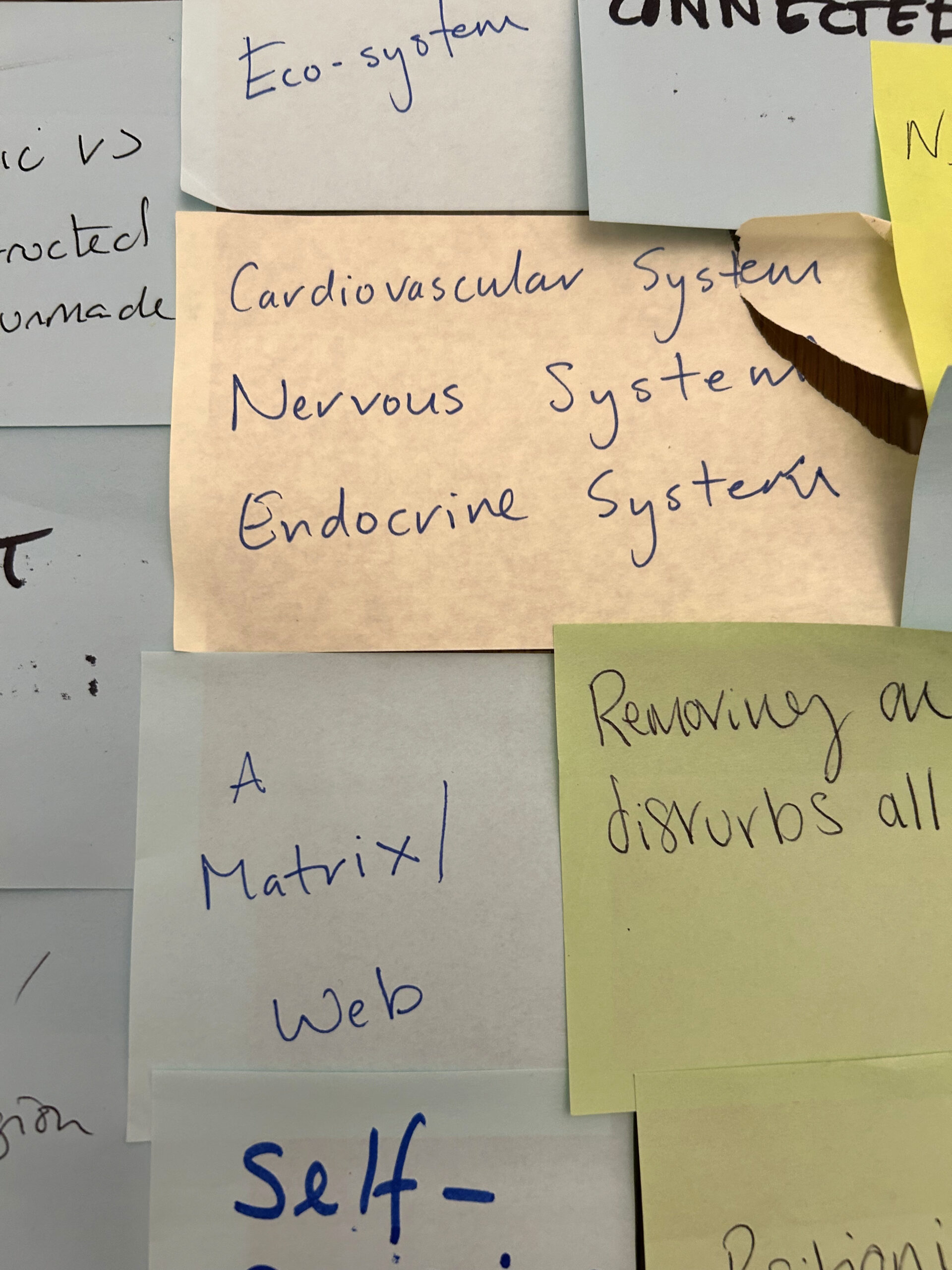
TASK: Collecting terms and resonances: Use the chat function or sticky notes to list terms or ideas that in any way come to you in relation to the notion ecosystems or arts as an ecosystem


Sticky-notes capture ideas and lists of words are made:

Relationship
Friendship
Interdependence

Evolving
Changing
Movement between
Oscillation
Cycle
Seasonal

Agency
Dialogue
Communication
Performed
Bodily
Fascial
Mycelium
Nurturing
Care
Collaboration

Self-governing
Pragmatic coalition

Resources
Funding

Crisis
Fragile
Instability
Tough
Hardship

In my grouping of words above I’m struck by the largely generative nature of many of the words – the sense that ecologies arise in co-formed ways and that they are also (always) changing. I wonder as the session continues about the last set of words – from Crisis to Hardship – and the extent of agency that is or isn’t possible by independent dance artists in these ecologies and how spaces are made for the increasingly wonderfully particularized approaches to dance practice.

The next task opens to the dancer’s experience and places the emphasis on how individuals interact – opening us to a discussion as to the landscape in which these interactions take place.

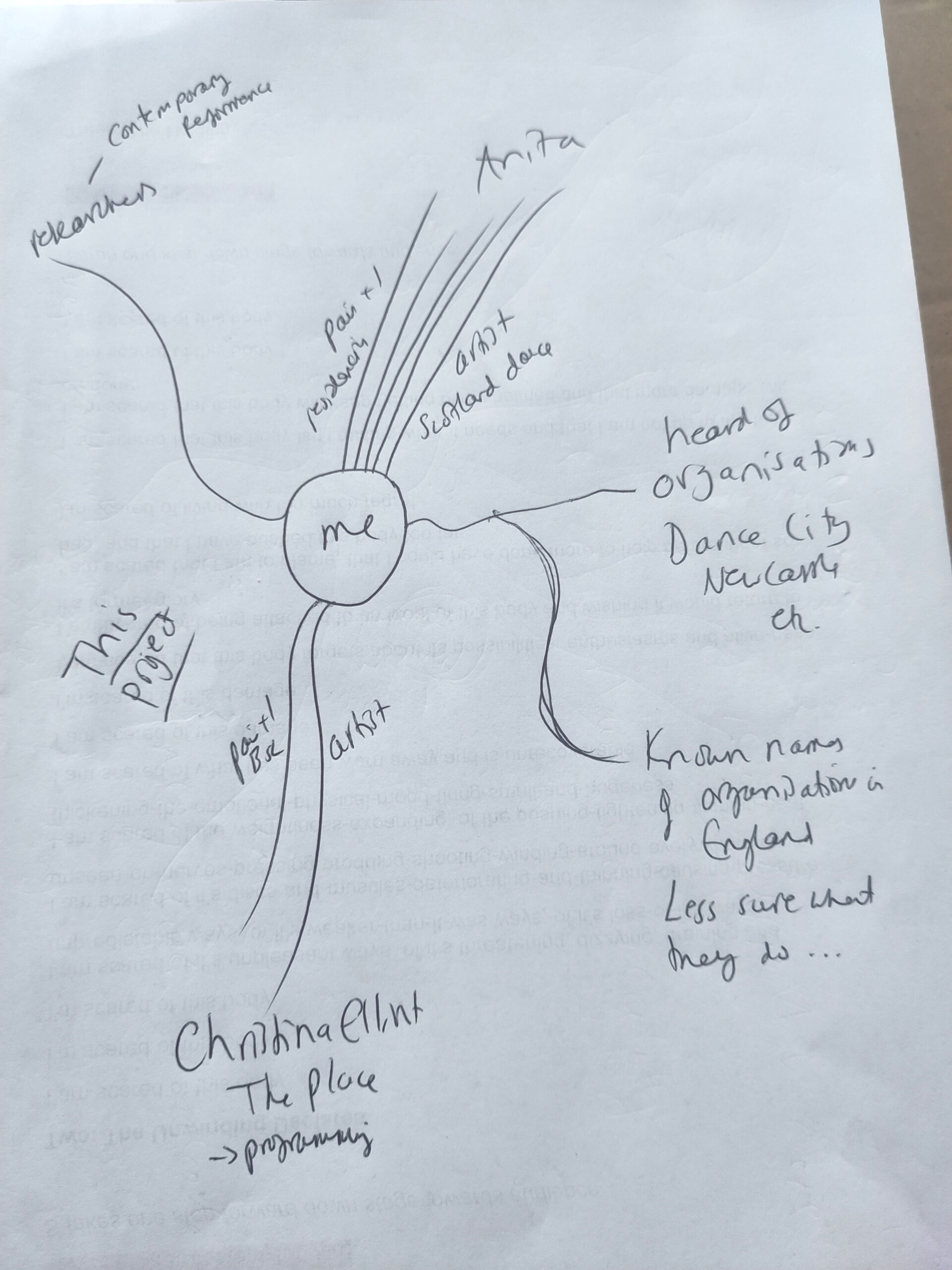
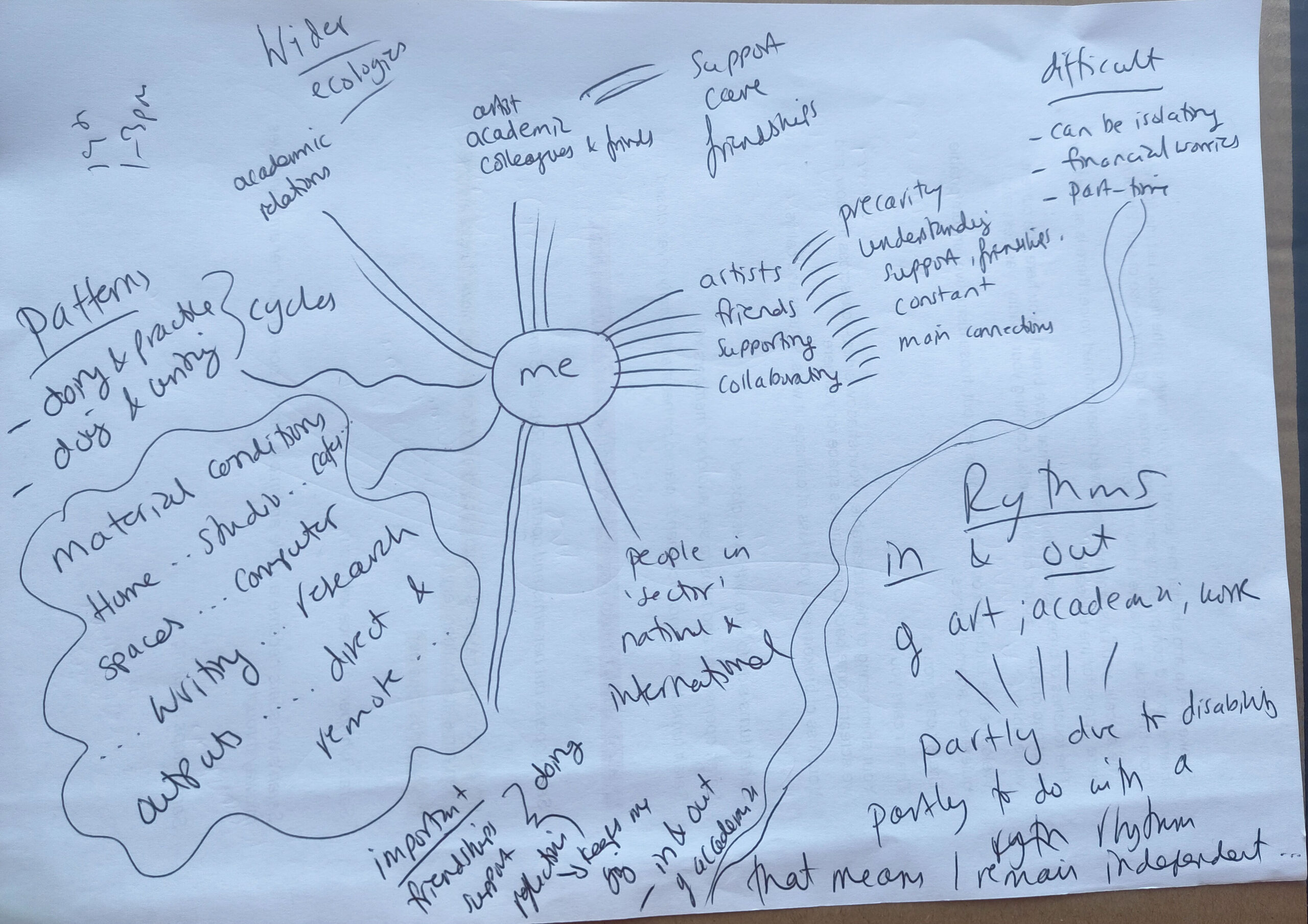
TASK: Visualise ecosystems in which you work: Map the systems through which your work operates.
What resides in your ecosystem? What is close/distant? What shape, rhythms, patterns or pulses does your ecosystems have? What are the characteristics of the material and social context of your dance ecosystem? Is the ecosystem in movement? What is important/difficult?


Words and images appear across large sheets of paper. Threads of connection, trees, plants and structures, columns and spirals, roads and maps.

roles (teacher, facilitator, researcher, producer)
activities (from performing, to making, to teaching, to producing, to shows, to touring), different types of practice (somatic, film, yoga, coaching),
venues and institutions (school, arts, galleries, HEI’s, NHS),
funders, communities and participants, research, collaborating,
working with partners and networking, commissions and funders.

Webs meshed and intertwined – patterns that allow a dance artist to exist in patterns that strive toward healthy balance and for self-care, yet these ideals sit in contrast to the striving to access resources to live, to dance, to facilitate creative practices in meaningful and sustainable ways.

I wonder when listening about how metaphors are. The landscape feels like a desert – but like all deserts a rich life is still present, even if often hidden, specialised and adaptive to the environmental conditions.

Vida Midgelow

Opening the Space – 1 at Yorkshire Dance

24 November 2023

One key aim of our network is to build stronger relationships between HE and the arts sector both through discussions between the members and by reaching out to include those who also have a place in the producing dance ecosystem. This approach also allows us to use a relationship-building strategy which suits our focus on practice – we create a network built on strong relationships by working together, and by reaching beyond the network members to take the ‘temperature’ of the wider dance sector.

We started this process by working with Yorkshire Dance on a day divided into two sessions, the first with Network Members, followed by a gathering of artists from across the region and joined by those online.

The work at this point takes the form of a scoping exercise – one which begins with almost no literature and little in the way of publicly available records that might offer insights into the current state of the art. But even at this initial stage we hope to make a meaningful contribution by making more visible the work of our arts partners, hearing the voices of the sector and gathering evidence of the trends that are emerging.

The day at Yorkshire Dance was lively, as the documentation which follows reveals – and the focus on the voices of the artists provided an important perspective for our work. Thank you to everyone at Yorkshire Dance and to Rachel Krische from Leeds-Beckett University who worked to make it happen.

Please follow our investigation over the months ahead and please also add your perspective, thoughts and comments.

Professor Christopher Bannerman

Introduction

The process of writing and submitting this application to the Arts and Humanities Research Council (AHRC) meant meeting the deadline of mid-March 2023 and starting work in October 2023. We were virtually certain from the outset that the impact of the challenges we identified were continuing and that turbulent times were coming. And unfortunately, so it has proved, with both the Higher Education and Arts sectors facing potentially existential threats from socio-economic headwinds, prevailing discourses and instability in the political space.

In essence our proposal is simple: we in dance need to bolster and formalise connectives between higher education and the cultural and creative sectors in terms of the currently deeply interwoven, but largely undocumented ecologies we inhabit and represent.

Our focus on producing dance is designed to focus attention on those who are best placed to address the challenges and identify new pathways and opportunities for the dance sector as a whole. This goes beyond the professional roles and related ‘producer’ job titles, to reveal how producing might be seen as central to the dance ecosystem, vital for sustaining artists and creative and embodied knowledge generation, and thereby extending and reframing understandings of practice-research to include many ways that dance reaches and engages a range of audiences.

Producing, taken conceptually and holistically, encompasses multifaceted processes of making things happen, of negotiating across constituencies to bring something into the world, of discovering, revealing and activating learning and new insights in, about and through dance. Producing also encompasses the creation and curation of meaningful engagements across a range of contexts that address broader social and cultural issues of equity and inclusion.

We plan to address another important absence in these turbulent times: there is no road map to sustainability, or model for even understanding the dance producing ecosystem despite the urgent need to consider and evaluate emerging developments to promote resilience and renewal. By encompassing a diverse range of dance cultures and research practices, we seek to identify new opportunities for the professional dance sector, to expand approaches to future dance research, to inform policymaking for dance and to demonstrate an ecosystem that is inclusive and dynamic.

These are ambitious aims in particularly challenging times, but we hope to hear your voices and to make a difference.

Professor Christopher Bannerman